Snapshots from the UC San Diego Jacobs School of Engineering.
Monday, March 19, 2012
Triton Day Experience / April 7
Friday, November 18, 2011
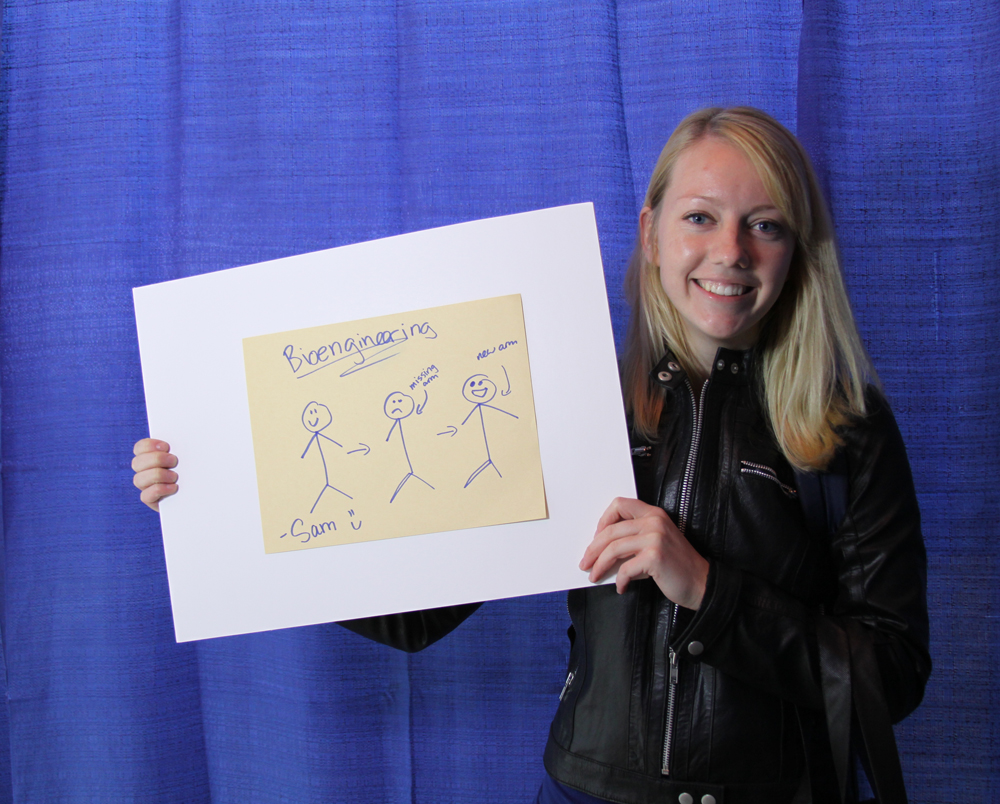
Jacobs School Photo Booth at UC San Diego Founders' Day Celebration
Renewable energy, health care and space travel / teleporting were popular, but answers spanned a wide range of topics. What will be the next big innovation or invention? How will it change the world? Your life? (Feel free to leave answers in the comments section, or on our Facebook page: http://www.facebook.com/UCSDJacobs
High resolution versions of these and more photos are on the Jacobs School of Engineering Flickr photostream. Even more photos from the photo booth are on our Facebook page.
A special thanks to Dr. Shu Chien for participating!
Thursday, November 17, 2011
Founders' Day Fun this Friday, Nov 18, 2011
Wednesday, November 2, 2011
Architectural Tours of UC San Diego / Coming in January 2012
Friday, August 12, 2011
UC San Diego Volunteer50 Nominated for Award
To vote for UC San Diego visit http://classyawards.
Wednesday, February 2, 2011
IDEaS: Innovation Day Expo and Symposia
Innovation Day Expo and Symposia (IDEaS) Feb. 22-25: this is a week of free events at UC San Diego that will feature dynamic leaders in the arts, sciences, technology, medicine and education who are making a positive impact in San Diego, the nation and the world.
Read the full story on the Jacobs School of Engineering news site.
Tuesday, September 28, 2010
The Fall Quarter is Here: This Week @ UCSD is Back
http://ucsdnews.ucsd.edu/thisweek/2010/09/27_index.asp, the weekly email on what is happening (and what just happened) at UC San Diego is back. Yesterday marked the first issue of This Week.
Subscribe to This Week here.
One of the links is to a new book on the UC San Diego campus.
Monday, August 2, 2010
Natural Reserve Videos from UC San Diego

I was poking around the UC San Diego Research Affairs site and stumbled on this collection of videos about various natural researves tied to UC San Diego. (The first video I clicked on required some buffering...but it was worth the wait...I learned about a protective seed pod that looks just like a "spiky loofah". The "spiky loofah" is from a plant called a "cucamonga manroot". The video is here: http://research.ucsd.edu/media/video/UCSDResearchVideo.aspx?v2Play=scripps_08.mov
Friday, May 28, 2010
UC San Diego Men's Baseball in College World Series Final Tomorrow

photo caption: UCSD shortstop Vance Albitz slides into home plate.
Photo/Willis Glassgow/WC Sports Photos
Monday, February 1, 2010
UCSD Alumni Magazine is Online

The latest issue of the UCSD alumni magazine is now online. You can get the online/print hybrid experience at: http://www.pursuantmedia.com/ucsd/0110/
Or hit this page for the UCSD alumni magazine:
Page 25 includes a Q&A with engineering alum Matt Newsome.
Thursday, October 29, 2009
UC San Diego Ranks 6th in Nation for R&D Dollars

The University of California, San Diego again ranks sixth among top U.S. universities in federal research and development expenditures for fiscal-year 2008, with $491 million in federal R&D money and $842 million in total R&D expenditures. The numbers were announced by the National Science Foundation (NSF).
Johns Hopkins University led the survey, followed by UC San Francisco, the University of Wisconsin at Madison, the University of Michigan (all campuses combined), UCLA, UC San Diego, Duke University, the University of Washington, the University of Pennsylvania, and Ohio State University. UC Davis and UC Berkeley ranked 16th and 18th, respectively.
UC San Diego’s faculty and alumni have created nearly 200 start-up companies, including many regional biotech companies. According to a recent study of the university’s economic impact, UC San Diego contributes more than $7.2 billion in direct and indirect spending and personal income each year to the California economy, generating more than 39,000 jobs. Read the full press release, written by UC San Diego’s Paul K. Mueller.
The North County Times covered this story, and included a nice graph.
Tuesday, April 28, 2009
MapLink - The UC San Diego Google Map Service....Finally
http://www-act.ucsd.edu/maps
>>I just clicked around a bit, and the satellite view is far better than the map view. Also, some of the road names around the engineering buildings don't seem right...but I'll to do a little more checking.
>>According to the email announcement of MapLink:
"MapLink is a web-based tool that allows you to find not only campus buildings but also relevant services like parking, restaurants, and shuttle stops, for both campus and the Hillcrest Medical Center.
Initially released in beta form in 2007, MapLink 1.0 now includes new features such as driving directions and better search capabilities, plus enhancements to make it more versatile, easier to maintain, and more responsive to users' feedback and questions. Another new feature allows users to link to specific map pages within MapLink, a refinement requested by many users."
Tuesday, March 4, 2008
San Diego is Amazing


San Diego is famous for its beaches and sunshine and proximity to both Mexico and LA. But there is much more. And if you end up coming to UCSD to study or work, you'll have the chance to explore San Diego county. You hear people say that you can hike in the mountains, hang out in the desert and watch the sun set over the ocean all in one day, without leaving San Diego county. It's true. And it's cooler than it sounds. And when we get our winter rains, the wildflowers are amazing.
Friday, December 7, 2007
Two ECE Profs, Two Spin-Outs, Two Product-Award Nominations…Just One Award


Products from two different companies spun out by electrical engineers at UC San Diego are finalists for CONNECT’s 2007 Most Innovative New Product “MIP” Award – in the Communications Technology & Hardware category.
CONNECT is a globally recognized public benefits organization that fosters entrepreneurship in San Diego. The winning product will be announced at a December 14, 2007 award ceremony.
The two UCSD spin-out companies are Mushroom Networks, Inc., founded by Rene Cruz, and Ortiva Wireless founded by Sujit Dey – both of whom are electrical engineers at the Jacobs School.
Mushroom Networks was nominated for its Broadband Bonding Network Appliance and Ortiva Wireless for Ortiva Mobile Content Delivery Network.
Mushroom Networks’ Broadband Bonding Network Appliance provides cost-effective accelerated Internet connectivity to entities within multi-tenant buildings who wish to aggregate multiple Internet access lines for increased performance and reliability. With the Broadband Bonding Network Appliance, up to five DSL, cable modem or T1 services can be combined.
The Ortiva Wireless Mobile Content Delivery Network gives content providers and aggregators an innovative, hosted means of managing and delivering content to mobile subscribers. It delivers smooth video, clear audio, and rich multimedia experience to mobile users under highly variable wireless network conditions. Ortiva’s mobile network operator solutions extend the coverage and expand the availability of rich media content.
Rene Cruz, an electrical engineer from UCSD, founded Mushroom Networks in 2004 with Dr. Cahit Akin. Cruz currently serves as Chief Science Officer. Cruz works in the area of performance analysis of communication networks and has developed traffic and service models for communication networks that have been widely adopted within the research community. He is an internationally recognized expert in the area of Quality of Service (QoS) guarantees in packet switched networks, and was elected to be a Fellow of the IEEE on the basis of these accomplishments.
Sujit Dey, an electrical engineer from UCSD, founded Ortiva Wireless in 2004 based on technologies developed at the Jacobs School. Dey heads the Mobile Systems Design and Test Laboratory within the Department of Electrical and Computer Engineering at the Jacobs School. He has twenty years of experience in research, technology, and product development in wireless networks, wireless multimedia, systems, circuits, and design tools. He currently serves as the Chief Technologist for Ortiva Wireless.
In 2004, Dey won a grant of $50,000 from the Jacobs School's von Liebig Center for Entrepreneurism and Technology Advancement to build a first proof-of-concept for software that dynamically shapes data in applications as a function of network and device conditions and constraints.
Rene Cruz received commercialization advisory services and incubation space from the von Liebig Center.
Friday, September 14, 2007
Computer Graphics Research featured in Science

For visual-effects creators, rendering objects like the mist-emitting Pensieve in Harry Potter is no mean feat. Even creating a realistic glass of milk can take computer artists hours of tedious work. But a new image-generating technique may accurately replicate many substances given only the type and amount of their ingredients.
"If we know what it's made of, we can say what it looks like," says computer scientist Henrik Jensen of the University of California, San Diego, who outlined the technique last week at a computer-graphics conference in San Diego.
Jensen, who won a 2004 Academy Award for a novel method of rendering skin that was used to create The Lord of the Rings' Gollum, worked with colleagues from the Technical University of Denmark in Lyngby to broaden a 100-year-old model of optical scattering called Lorenz-Mie theory. The team extended it to include irregularly shaped particles like the constituents of milk, seawater, and other light-absorbing substances.
The technique can also be run in reverse to derive a substance's composition from digital photographs. Commercially, this could make it possible to spot spoiled or contaminated food. A Danish company, Danisco, is interested in using it to check the freshness of milk and ice cream.
Wireless Research Featured in Technology Review
Watching Wi-Fi: This schematic illustrates the Wi-Fi access points (in red) and the radios (in black) that monitor traffic in the computer-science building at UCSD. Below: two traffic-monitoring radios on a wall. Credit: University of California, San Diego
Thursday, September 6, 2007
Taking the Why out of Wireless
"People expect WiFi to work, but there is also a general understanding that it’s just kind of flakey,” said Stefan Savage, one of the UCSD computer science professors who led development of an automated, enterprise-scale WiFi troubleshooting system for UCSD’s computer science building. The system is described in a paper presented last week in Kyoto, Japan at ACM SIGCOMM, one of the world’s premier networking conferences.
“If you have a wireless problem in our building, our system automatically analyzes the behavior of your connection – each wireless protocol, each wired network service and the many interactions between them. In the end, we can say ‘it’s because of this that your wireless is slow or has stopped working’ – and we can tell you immediately,” said Savage.
"Our system is the ultimate laboratory for testing new wireless gadgets and new approaches to building wireless systems. We just started looking at WiFi-based Voice-Over-IP (VOIP) phones," Savage said.
You can read more about this here.
Stefan Savage is a UCSD computer science professorand one of the leaders of the UCSD wireless monitoring project.
Friday, August 31, 2007
Digital Dandelions Bloom in Japan

Digital dandelions are blooming at SIGCOMM 2007 in Kyoto, Japan. This paper is about creating random maps of the Internet that capture things like the interconnectivity characteristics of the actual Internet. One of the things they measure is "betweenness." Between you and me, I'm a big fan of "betweenness." You can read the press release or go to the actual SIGCOMM paper.

Tuesday, August 28, 2007
Bandwidth on a Diet

There is very little portion control on the Internet -- there is nothing to keep you from watching You Tube videos all day. This lack of portion control pops up on the Internet in lots of other ways as well. For example, Barath Raghavan (UCSD computer science PhD student) told me that bandwidth gets gobbled up in cloud-based environments as if it were one big all-you-can-eat bandwidth buffet. Why? Because there is no way to portion control, co-ordinate or otherwise dynamically manage the bandwidth that is used within computing clouds. You can control the bandwidth at any one location, but you can't say, "I want to spread by 50Mb/s of bandwidth across my mirrors, and I want the most bandwidth available where there is the most demand." Well, you CAN say it...but it won't happen.