
Snapshots from the UC San Diego Jacobs School of Engineering.
Wednesday, October 21, 2009
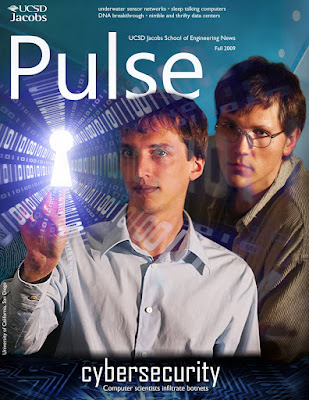
Pulse magazine is online: Fall 2009
The Fall 2009 issue of Pulse is out! Pulse (archive is here) is the magazine of the UC San Diego Jacobs School of Engineering.


Monday, October 19, 2009
Cyberlink October 2009

Stay in touch with CI-related news & events with UC San Diego CyberLink!
UC San Diego CyberLink is a monthly digest of news and events related to cyberinfrastructure from San Diego Supercomputer Center (SDSC), California Institute for Telecommunications and Information Technology (Calit2), Jacobs School of Engineering, UC San Diego Libraries, Administrative Computing & Telecommunications (ACT) and Center for Research in Biological Structures (CRBS). If you have news to share about cyberinfrastructure-related research, applications or activities on the UC San Diego campus, please send them to cyberlink@ucsd.edu.
Neuroscience Information Framework Releases Version 2.0
At the 39th annual meeting of the Society for Neuroscience (SfN), a national collaboration led by UC San Diego – the Neuroscience Information Framework (NIF) – unveiled its second iteration as a resource to improve information retrieval in the neurosciences. Apart from a redesigned site, NIF 2.0 makes Framework resources available as open access data, and it marks the start of a transition for SfN's Neuroscience Database Gateway to the NIF platform.
Waitt Family Foundation Project Develops Whole Brain Catalog™
Researchers in UCSD's Center for Research in Biological Systems (CRBS) will demo a beta version of this cyberinfrastructure-connected resource at Neuroscience 2009 starting Oct. 18 in Chicago. In time, the resource “may constitute the largest single gateway to brain science research data,” says Ted Waitt, whose Waitt Family Foundation is funding the effort. The Catalog™ will integrate diverse brain data sets, at many different scales, and give researchers everywhere access to the data via 3D, high-resolution visualization tools.
Encrypted Wireless Required Starting November 9
ACT is nearing completion of a broad upgrade to the campus wireless networking services. The final phase involves the use of the encrypted wireless network, UCSD-PROTECTED. All faculty, staff, and students who use WiFi on campus and need access to restricted UCSD resources are required to configure their computers to use UCSD-PROTECTED by Nov. 9. The old "UCSD" unencrypted wireless network, which doesn't protect communications, is expected to be turned off on that date. Visitors can use the UCSD-GUEST network, which provides general Internet access (but no access to restricted campus resources). The ACT Help Desk will offer support sessions on different areas of the campus the week of November 2.
Online 'Museum' Compares Humans with Our Closest Evolutionary Relatives
The cyberinfrastructure experts at SDSC and Calit2 have helped create an online Museum of Comparative Anthropogeny. It's the online presence of a joint UC San Diego and Salk Institute Center for Academic Research and Training in Anthropogeny (CARTA), linking researchers and the public to a web-based collection of comparisons between humans and our closest evolutionary relatives, including chimps and gorillas.
National LambdaRail Turns Six and Celebrates Calit2, Other Early Adopters
To celebrate the sixth anniversary of its backbone going operational, NLR published an online report about early adopters, including Calit2 and its partner in the OptIPuter project, EVL at the University of Illinois at Chicago. EVL and Calit2 leased a dedicated 10 Gbps circuit between San Diego and Chicago in September 2004, and it was extended to NASA Goddard and J. Craig Venter Institute in Maryland, and last year another switch was installed by CENIC/NLR to hook up HP Labs to the EVL/Calit2 “CAVEwave” at 10 Gbps for joint research.
SDSC Part of $15 Million Project to Create 'FutureGrid' Network
SDSC is part of a team chosen by the National Science Foundation (NSF) to build and run an experimental high-performance grid test-bed, allowing researchers to collaboratively develop and test new approaches to parallel, grid and cloud computing.
HPWREN Enhances Situational Awareness for First Responders
Emergency responders are typically hampered by a lack of real-time situational awareness when making critical decisions in response to rapidly changing conditions and life-threatening situations. In order to provide enhanced situational awareness to responders on the ground, MIT Lincoln Laboratory -- with the assistance of the High Performance Wireless Research and Education Network (HPWREN) -- has installed a camera system with real-time video downlink capability on a Cal Fire emergency-response aircraft.
New Saudi University Opens Its Doors -- and Stunning Visualization Facilities
Half a dozen advanced visualization facilities prototyped at UCSD by Calit2 before being built in Saudi Arabia were on display when the King Abdullah University of Science and Technology (KAUST) officially opened its doors on Sept. 23. Highlights included the CORNEA VR environment (with the world's highest resolution “CAVE” environment), which also sports the most advanced spatial/surround sound system in the world.
Calit2 Researchers Model Ancient Maya City in Google SketchUp
Archaeologists affiliated with Calit2's Center of Interdisciplinary Science for Art, Architecture and Archaeology (CISA3) used an open-source Google download to create detailed, 3D visualizations of the Mayan ruins at Chichén Itzá. The ultimate goal of the project: a Web-based interactive research environment, or “virtual city,” accessible via cyberinfrastructure from anywhere in the world.
Netflix Turned to Computer Science Professor for Million Dollar Competition
Data mining expert and computer science professor Charles Elkan served as a contest designer, consultant and judge for the Netflix Prize. Elkan runs his own annual data mining contest.
Fast and Accurate Analog-to-Digital Converters
Analog-to-digital pioneer and electrical engineering professor Ian Galton is the featured innovator in the September 2009 newsletter from the UC San Diego Technology Transfer Office.
Cyberinfrastructure Is Part of $105 Million NSF Earthquake Engineering Center
Jacob s School structural engineers are part of a $105 million grant from the National Science Foundation to create a headquarters —including extensive cyberinfrastructure—for the George E. Brown, Jr. Network for Earthquake Engineering Simulation (NEES).
MARK YOUR CALENDAR…… for these upcoming cyberinfrastructure-connected events and training sessions. All events will be held at UC San Diego (except where noted otherwise).
October 14, 2009 – 1:00-3:00pm – Weaver Center, Institute of the Americas, UC San Diego
3rd Annual SysAdmin Expo – Part One UCSD systems administrators and department network managers are encouraged to attend the annual SysAdmin Expo. Part One offers the opportunity to meet the people who provide many of the technical services on campus, including: ACMS and ACT Help Desks; Campus Web Office; Hostmaster; SDSC; Security; and UCSD Network. See below for more on Part Two, scheduled for Nov. 18.
October 22, 2009 – 5-7pm – SDSC Auditorium, San Diego Supercomputer Center
Newton's Laws of Gravity: From the Celestial to the Terrestrial
The basic ideas worked out by Galileo, Newton and others will be explored and made accessible with a combination of in-class experiments, “thought experiments” realized by animations, and selected video clips for our recent but rich history of space exploration.
October 24, 2009 – 9am-Noon – SDSC Auditorium, San Diego Supercomputer Center
Students Modeling A Research Topic
The San Diego-based SMART Team program, a Howard Hughes Medical Institute-supported pre-college science outreach program to introduce high school students to basic concepts in protein structure, will focus during this session on “Using RasMol for Protein Visualization.”
November 6, 2009 – 11am-Noon – Auditorium, Room 1202, CSE Building, UC San Diego Powering Future System Innovations
Intel Labs VP Wen-Hann Wang, who also directs Intel's Circuits and System Research, will talk about the need for “revolutionary” thinking in research on the building blocks of systems. Wang will focus on five key sub-system vectors: security and trust; resiliency; memory hierarchy, I/O, and energy efficiency. This talk is part of the 2009-10 UCSD Center for Networked Systems (CNS) Lecture Series.
November 18, 2009 – 1:00-3:00pm – Weaver Center, Institute of the Americas, UC San Diego 3rd Annual SysAdmin Expo – Part Two
UCSD systems administrators and department network managers are encouraged to attend the annual SysAdmin Expo. Part Two of the SysAdmin Expo (Part One took place on Oct. 14) features an update on ACT activities – a review of the past year and what's in store for the 2009-‘10 academic year.
The agenda will include talks by CNS's industry affiliates on current research challenges and concerns, progress reports from UCSD researchers conducting CNS-sponsored projects, a graduate student research poster session, and numerous opportunities for information interactions with CNS faculty, researchers and graduate students. Attendance is limited to industry sponsors and invited guests. For more information, contact Kathy Krane at mailto:kkrane@ucsd.eduor call 858-822-5964.
Jan. 25 - 28, 2010 – Calit2 Auditorium, Atkinson Hall, UC San Diego
8th International Conference on Creating, Connecting & Collaborating through Computing
The C5 conference focuses on ways to transform computer-based human activities for creating and collaborating as a knowledge society emerges from now-pervasive computers, networks and other technologies. Talks will focus on visualization; collaboration and communication; technology-human interaction; virtual worlds; social networks; learning and much more. Paper submission deadline: Oct. 23.
Wednesday, October 14, 2009
Bioengineering Grad Student Wins Quick Pitch Competition for Entrepreneurs
Bioengineering Ph.D. student and cancer diagnostics pioneer Raj Krishnan won the “Best Pitch” award at the 3rd Annual Tech Coast Angel (TCA) Quick Pitch Competition.
Competition participants had a maximum of 2 minutes and 5 slides to sell their company story to the approximately 300 attendees, including potential investors.
“There were 3 prizes, Best Pitch, Best Content and Best Overall. We won the Best Pitch prize for the best presentation they had seen at the competition,” wrote Krishnan in an email. Krishnan is the founder of Biological Dynamics, an early stage startup with its sights set on the early cancer diagnosis market.
The technology behind Krishnan’s quick pitch may eventually lead to early stage cancer diagnostics through better ways to identify and separate secondary cancer biomarkers directly from blood, such as cell-free circulating high molecular weight DNA. For this research, Krishnan won the top prize at the 2009 Jacobs School Research Expo. Read more about the technology and Krishnan’s winning streak here.
“Winning the competition gives us the opportunity to get our name out there further, and gives us another award as recognition for our capabilities. We hope to use the competition as a way to attract further investment into our company so that we can begin development on our early cancer screening device,” wrote Krishnan.
At the Tech Coast Angels Quick Pitch event, the Best Content award went to ecoATM
which produces eCcycling stations for automated electronics recycling. The Best Overall award went to Radical Therapeutix, which is developing a new heart disease drug.
Competition participants had a maximum of 2 minutes and 5 slides to sell their company story to the approximately 300 attendees, including potential investors.
“There were 3 prizes, Best Pitch, Best Content and Best Overall. We won the Best Pitch prize for the best presentation they had seen at the competition,” wrote Krishnan in an email. Krishnan is the founder of Biological Dynamics, an early stage startup with its sights set on the early cancer diagnosis market.
The technology behind Krishnan’s quick pitch may eventually lead to early stage cancer diagnostics through better ways to identify and separate secondary cancer biomarkers directly from blood, such as cell-free circulating high molecular weight DNA. For this research, Krishnan won the top prize at the 2009 Jacobs School Research Expo. Read more about the technology and Krishnan’s winning streak here.
“Winning the competition gives us the opportunity to get our name out there further, and gives us another award as recognition for our capabilities. We hope to use the competition as a way to attract further investment into our company so that we can begin development on our early cancer screening device,” wrote Krishnan.
At the Tech Coast Angels Quick Pitch event, the Best Content award went to ecoATM
which produces eCcycling stations for automated electronics recycling. The Best Overall award went to Radical Therapeutix, which is developing a new heart disease drug.
Facetime with Facebook

UC San Diego students and faculty got some quality “face time” with Facebook last Thursday. At a morning lecture in the Calit2 auditorium, Jeff Rothschild (photo, right), Facebook's vice president of technology, spoke about scaling, or how a growing company addresses technological and organizational challenges. Watch the video of Rothschild at: http://video-jsoe.ucsd.edu/asx/JeffRothschildFacebook.asx
Facebook’s Taner Halicioglu (photo, left) also came to campus. Halicioglu earned some of his computer science “street cred” here at the Jacobs School. He graduated from Revelle College in 1996, and joined Facebook as the company’s first outside hire, in 2004.
Below are a few more details from Halicioglu’s talk, as reported in Roxana Popescu’s “@ UCSD” story. http://ucsdnews.ucsd.edu/thisweek/2009/10/12_facebook.asp
“He [Halicioglu] recalled how he ‘pretty much lived in the data center’ in his first months with the company and summarized some of the company’s core principals with playful alliterations. Simplicity is sublime. Abstraction is awesome. Data is delicious.”
Facebook representatives also participated in a series of technical meetings with UCSD faculty and students, hosted by Amin Vahdat, a professor of computer science and engineering and director of the Center for Networked Systems at the Jacobs School of Engineering.
Facebook’s Taner Halicioglu (photo, left) also came to campus. Halicioglu earned some of his computer science “street cred” here at the Jacobs School. He graduated from Revelle College in 1996, and joined Facebook as the company’s first outside hire, in 2004.
Below are a few more details from Halicioglu’s talk, as reported in Roxana Popescu’s “@ UCSD” story. http://ucsdnews.ucsd.edu/thisweek/2009/10/12_facebook.asp
“He [Halicioglu] recalled how he ‘pretty much lived in the data center’ in his first months with the company and summarized some of the company’s core principals with playful alliterations. Simplicity is sublime. Abstraction is awesome. Data is delicious.”
Facebook representatives also participated in a series of technical meetings with UCSD faculty and students, hosted by Amin Vahdat, a professor of computer science and engineering and director of the Center for Networked Systems at the Jacobs School of Engineering.
Monday, October 12, 2009
Tijuana River photographs by Founding Dean of Jacobs School on Display at Calit2

Lea Rudee—the founding dean of the UC San Diego Jacobs School of Engineering—is an accomplished photographer whose work Tijuana River is part of a seven-artist show focused on hot-button issues tied to the border dividing San Diego and Tijuana.
Tijuana River documents the river’s meandering path across the border and its many roles as drainage creek, city water supply, border crossing obstacle, and preserved salt marsh. “In less than 100 miles, the Tijuana River has many identities,” said Rudee in an interview with Calit2’s Doug Ramsey. (Read the full Calit2 press release here.)
“Tijuana/San Diego: Cooperation and Confrontation at the Interface” opens officially on Oct. 15 in the gallery@calit2 on the first floor of Atkinson Hall on the University of California, San Diego campus. The gallery is part of the UC San Diego division of the California Institute for Telecommunications and Information Technology (Calit2).
Rudee noted that on the U.S. side, most of the water becomes part of San Diego’s water supply. “On the Mexican side, some of the water serves Tijuana, but occasional floods produce damage to downstream development, causing resentment by the local inhabitants.” It took Rudee over four years to document on film every stretch of the Tijuana River.
Rudee is a professor emeritus in the Department of Electrical and Computer Engineering and former trustee and president of San Diego’s Museum of Photographic Arts.
Tijuana River is part of the Calit2 exhibition “Tijuana/San Diego: Cooperation and Confrontation at the Interface” that deals head-on with politics, immigration, the environment and other hot-button issues - through the lens and sensibility of artists working in multiple media.
Tijuana River documents the river’s meandering path across the border and its many roles as drainage creek, city water supply, border crossing obstacle, and preserved salt marsh. “In less than 100 miles, the Tijuana River has many identities,” said Rudee in an interview with Calit2’s Doug Ramsey. (Read the full Calit2 press release here.)
“Tijuana/San Diego: Cooperation and Confrontation at the Interface” opens officially on Oct. 15 in the gallery@calit2 on the first floor of Atkinson Hall on the University of California, San Diego campus. The gallery is part of the UC San Diego division of the California Institute for Telecommunications and Information Technology (Calit2).
Rudee noted that on the U.S. side, most of the water becomes part of San Diego’s water supply. “On the Mexican side, some of the water serves Tijuana, but occasional floods produce damage to downstream development, causing resentment by the local inhabitants.” It took Rudee over four years to document on film every stretch of the Tijuana River.
Rudee is a professor emeritus in the Department of Electrical and Computer Engineering and former trustee and president of San Diego’s Museum of Photographic Arts.
Tijuana River is part of the Calit2 exhibition “Tijuana/San Diego: Cooperation and Confrontation at the Interface” that deals head-on with politics, immigration, the environment and other hot-button issues - through the lens and sensibility of artists working in multiple media.
Exhibition Hours
October 5-November 25, 2009 Monday-Friday, 11am-5pm* gallery @ calit2 Atkinson Hall University of California, San Diego 9500 Gilman Drive, La Jolla, CA 92093 Map & Directions: http://atkinsonhall.calit2.net/directions/ http://gallery.calit2.net/ http://www.calit2.net/ * [Note: Closed Nov. 11 in observance of Veterans Day]
Panel Discussion*
October 15, 2009, 4-5pm
Calit2 Theater, Atkinson Hall, UC San Diego
Gallery Reception*
October 15, 2009 5-7pm
Lobby and Gallery, Atkinson Hall, UC San Diego
* Note: Panel discussion and gallery reception open to the public; RSVP requested to Trish Stone, Gallery Coordinator, tstone@ucsd.edu or (858) 336-6456 .
Friday, October 9, 2009
Stem Cell Techniques Advance Liver Research

UC San Diego researchers are using stem cell technologies in order to do the basic research necessary to develop treatments for liver fibrosis—which according to information on PubMed is “the excessive accumulation of extracellular matrix proteins including collagen that occurs in most types of chronic liver diseases.”
Put another way, liver fibrosis is the formation of scar tissue in response to liver damage. Hepatic stellate cells--the major cell type involved in liver fibrosis--are responsible for secreting collagen that produces a fibrous scar, which can lead to cirrhosis.
The high-throughput cellular array technology developed by UCSD researchers systematically assesses and probes the complex relationships between hepatic stellate cells and components of their microenvironment. The scientists found that certain proteins are critical in regulating activation of hepatic stellate cells and that the proteins influence one another’s actions on the cells. The findings were published in a paper entitled “Investigating the role of the extracellular environment in modulating hepatic stellate cell biology with array combinatorial microenvironments” in the September 2009 issue of Integrative Biology. Authors: David A. Brafman, Samuele de Minicis, Ekihiro Seki, Kevan D. Shah, Dayu Teng, David Brenner , Karl Willert and Shu Chien.
Put another way, liver fibrosis is the formation of scar tissue in response to liver damage. Hepatic stellate cells--the major cell type involved in liver fibrosis--are responsible for secreting collagen that produces a fibrous scar, which can lead to cirrhosis.
The high-throughput cellular array technology developed by UCSD researchers systematically assesses and probes the complex relationships between hepatic stellate cells and components of their microenvironment. The scientists found that certain proteins are critical in regulating activation of hepatic stellate cells and that the proteins influence one another’s actions on the cells. The findings were published in a paper entitled “Investigating the role of the extracellular environment in modulating hepatic stellate cell biology with array combinatorial microenvironments” in the September 2009 issue of Integrative Biology. Authors: David A. Brafman, Samuele de Minicis, Ekihiro Seki, Kevan D. Shah, Dayu Teng, David Brenner , Karl Willert and Shu Chien.
Read more here:
http://www.jacobsschool.ucsd.edu/news/news_releases/release.sfe?id=895
This interdisciplinary research project involved both Dr. Shu Chien, Jacobs School bioengineering professor and Director of the Institute of Engineering Medicine at UCSD; and Dr. David Brenner, Vice Chancellor for Health Sciences and the Dean of the UCSD School of Medicine.
http://www.jacobsschool.ucsd.edu/news/news_releases/release.sfe?id=895
This interdisciplinary research project involved both Dr. Shu Chien, Jacobs School bioengineering professor and Director of the Institute of Engineering Medicine at UCSD; and Dr. David Brenner, Vice Chancellor for Health Sciences and the Dean of the UCSD School of Medicine.
Computer Science Alum "Building" Rome in a Day

Computer scientists around the world are working on various projects that involve automated reconstruction of 3-D images from photos pulled off the Web. One of the researchers working in this area is Sameer Agarwal, who earned his computer science PhD here at the Jacobs School of Engineering. Agarwal is now Acting Assistant Professor of Computer Science & Engineering at the University of Washington.
National Geographic recently profiled Agarwal's "building-Rome-in-a-day" work. Read the story at http://news.nationalgeographic.com/news/2009/09/090924-flickr-rome-build-day.html
Sameer Agarwal earned his PhD in the Computer Vision Laboratory at UC San Diego, where Serge Belongie was his advisor. At UCSD, Agarwal worked on a similar project--from pictures to three dimensions--with Department of Computer Science and Engineering PhD student Manmohan Chandrakar (who just started a post-doc at UC Berkeley with Prof. Ravi Ramamoorthi). Excerpt from that 2008 story below:
Your pictures of the Grand Canyon, Times Square or other destinations may be pretty good, but wouldn’t it be nice to show them off in three dimensions? An award-winning 3D reconstruction algorithm designed by a team of computer science researchers from UC San Diego brings this dream within the grasp of reality.
This research gets at the heart of “autocalibration,” a well-studied, fundamental problem in computer vision. Autocalibration aims to recover the three dimensional structure of a scene using only its images, acquired from cameras whose internal settings and spatial orientations are unknown.
Subscribe to:
Posts (Atom)
