Learn more by downloading the Medical Device Engineering PDF
Snapshots from the UC San Diego Jacobs School of Engineering.
Thursday, July 21, 2011
Medical Device Engineering / Attend a Free Informational Roundtable
Learn more by downloading the Medical Device Engineering PDF
Friday, February 4, 2011
Warehouse Fire Video / Story
Read the full story on the Jacobs School of Engineering news site:
UC San Diego Engineers Play Role in Warehouse Fire Safety
Check out the short video clip from YouTube embedded below.
Wednesday, January 26, 2011
UC San Diego Weather Balloon Journeys South of the Border
It’s a bird… it’s a plane… no wait a minute... it’s a weather balloon. A weather balloon recently launched from the UC San Diego campus traveled 300 miles until landing on a mountain slope between Puerto Penasco and Caborca, Mexico on the north-eastern edge of the Gulf of California.
The weather balloon, equipped with data transmitters and GPS locators, was launched by a group of UC San Diego mechanical and aerospace engineering students. The students, led by Prof. John Kosmatka, initiated the launch to flight test and develop experience with zero-pressure balloons. The students’ previous weather balloons traveled to a much higher altitude (90,000 feet or 17 miles) and burst, but traveled a short distance (5-10 miles). Zero- pressure balloons, such as the one used in the recent launch, rise to a predetermined altitude (such as 45,000 feet or 9 miles up - the lower edge of the stratosphere), then are pushed by the winds until they gently come down in the evening as the air and helium cool.
For Kosmatka and his students, the recent launch was a huge success.
“We learned that these balloons are very easy to load, launch, and track,” Kosmatka said. “Experimental data can be recorded and transmitted via ham radios to the internet, so that anyone in the world can monitor the flight progress. For this flight we monitored GPS location (latitude, longitude), altitude, speed, temperature, and air pressure. For most of the six-hour flight, the balloon cruised at 45,000 feet (lower edge of the stratosphere) where the air temperature is close to minus 60 Fahrenheit and the air pressure is only 2 pounds per second.
“These balloons have the research advantage in that data can be collected across a greater area at a specific altitude assuming that the winds are blowing in the right direction and are strong enough,” he added.
Kosmatka and his students plan to develop a variety of environmental and structural engineering experiments that will be flown on a future flight along with science payloads provided by local high school students.
The engineers have launched a total of six weather balloons since 2008. The launches are sponsored by the California Space Grant Consortium. Last fall, the students sent a weather balloon up 80,000 feet to near space to study the effects of solar power, climate change and the survival rate of anti-freeze beetles. Read more about that launch here.
Track the progress of previous and future balloon launches on the UCSD Near Space Balloon site.
Tuesday, January 18, 2011
NOVA: Making Stuff Stronger / Jacobs School Research
January 19 is the premier of "Making Stuff: Stronger" on NOVA. I haven't seen the show, but from the preview it looks like research from Jacobs School of Engineering professor Marc Meyers made it into the final version. Meyers is a professor in the Department of Mechanical and Aerospace Engineering (MAE).
Tuesday, January 11, 2011
UCSD Engineers Give Solar Power a Boost
![]() |
| UCSD Environmental Engineering professor Jan Kleissl |
Thursday, September 16, 2010
Mechanical Engineering Major / Water Polo Player named Athete of the Week

As a Junior in 2009, Madsen finished second on the team with 37 goals scored and added 20 assists. He scored three goals in an exciting 14-13 overtime win over Redlands in the first-round of the WWPA Championship tournament. He also scored two goals in an 8-7 upset win over Concordia at the Northern California tournament.
Learn more about Madsen on the UC San Diego Athletics Web site.
Keep up with UC San Diego Athletes of the Week Winners here.
Tuesday, September 7, 2010
Engineering and Science of Surfboard Story in the San Diego Union Tribune
Here is the online version of the Union Tribune science of surfing story by Lily Leung. (Check out the videos here and here and the photos are on the Jacobs School Flickr account. the original Jacobs School surfing story is here.)
Friday, August 27, 2010
Surf Video on Engadget
The exposure pushed one of the two related surfing videos on YouTube to almost 10,000 views. Check out the second Jacobs School surfing video on YouTube here.
Thursday, August 19, 2010
Surfing Discovery News
![]() |
| http://cse-ece-ucsd.blogspot.com/2010/08/surfboard-with-onboard-computer-youtube.htmlhttp://news.discovery.com/tech/computer-hangs-ten-on-surfboard.htmlBenjamin Thompson surfs the board with onboard computer. Image credit: UC San Diego |
![]() |
| Benjamin Thompson surfs the board with onboard computer. Image credit: UC San Diego |
The UC San Diego surfboard with onboard computer story is on the Discovery.com Web site. Check it out.
Tuesday, August 10, 2010
Surfboard with Onboard Computer / Photos
(See even more photos on the Jacobs School Flikr site)
Videos are here.
(See even more photos on the Jacobs School Flikr site)
Above caption: Benjamin Thompson takes the surfboard with onboard computer down to Windansea Beach in La Jolla, California. Photo credit: UC San Diego
Above caption: (L-R): Benjamin Thompson surfs the data-collecting surfboard. The onboard computer is visible at the front of the board. Photo credit: UC San DiegoAbove caption: (L-R): Structural engineering Ph.D. student Benjamin Thompson preps one of the surfboards he plans to use in upcoming board flexibility tests. Photo credit: UC San Diego
Friday, July 30, 2010
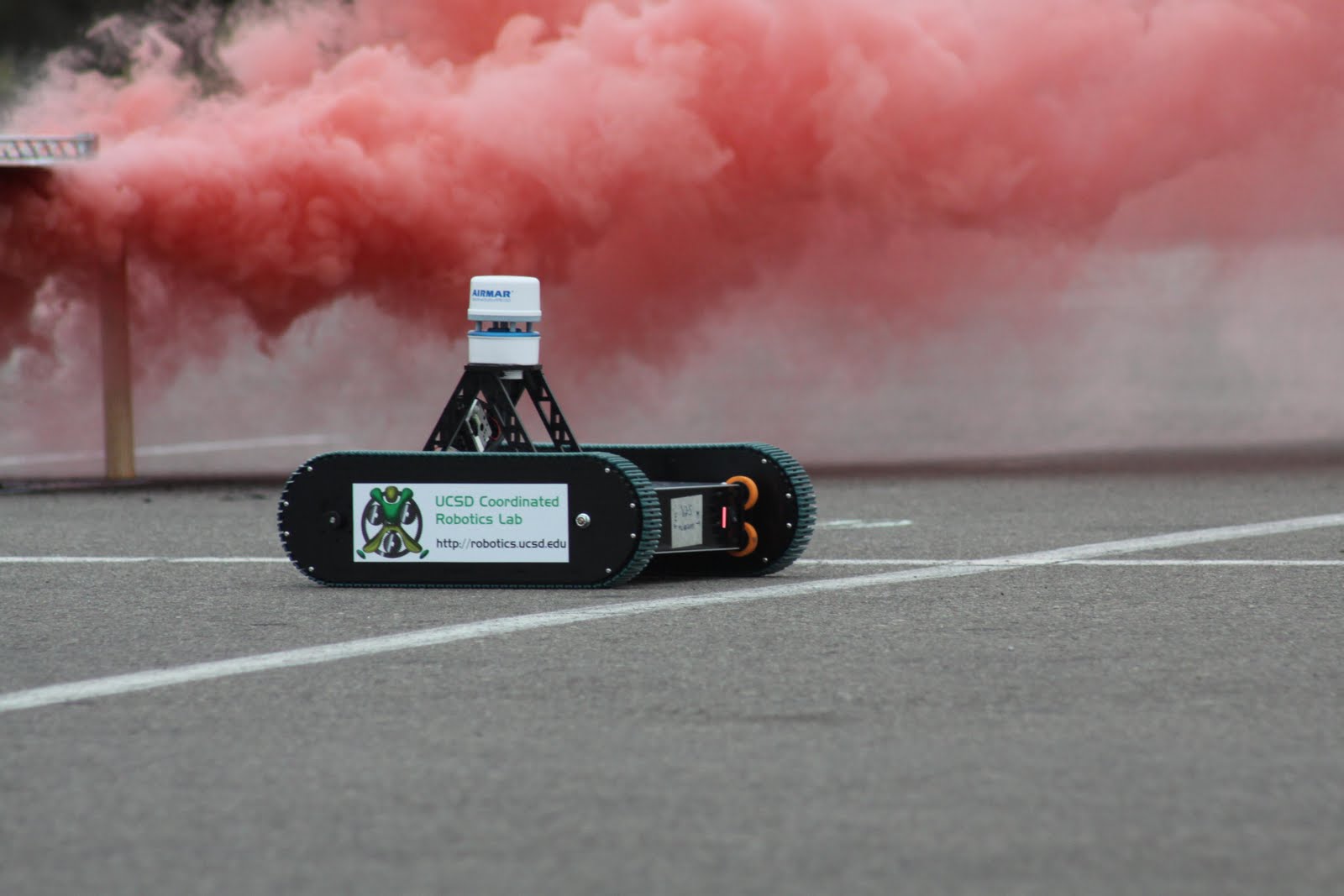
Smoke-Tracking Robots
Above and below are images from today's morning test of the smoke-tracking robots from the Bewley robotics lab in the MAE department here at the Jacobs School. This morning, the mechanical engineers tested their robots along with complex controls systems in a proof-of-concept systems integration test.
The student below is MAE Ph.D. student Nick Morozovsky, the lead student on this project.
Thursday, July 29, 2010
Wednesday, July 28, 2010
Robots will Navigate Smokey Parking Lot, Algorithms Will Predict Where Smoke Will Move

Friday, July 16, 2010
Enhancing Heart Surgery For Children

UC San Diego mechanical and aerospace engineering professor Alison Marsden is working through an international collaboration to develop multiscale models for all three stages of the surgery used to treat children with single ventricle heart defects. The end goal of the $6 million project, funded by Fondation Leducq in France, is to produce software that can be used for clinical decision support. These surgeries are typically done with three stages starting from birth: the Norwood (or variant), Glenn procedure, and Fontan surgery. According to Marsden, these young patients are among the most challenging for pediatric cardiologists to treat, and they can develop a number of very serious morbidities.
“While our group at UCSD has done research previously on the Fontan surgery (stage three), we were not able to take advantage of closed loop models of the circulatory system,” she said. “This collaboration will allow us to model the surgical connection in detail as well as the response of the entire circulation. In addition, this is the first time in our research group that we are taking a close look at the engineering aspects of the first two stages of the surgery, and that will hopefully shed light on possibilities for earlier interventions that can help prevent poor outcomes. The network gives us access to a large pool of clinical data through several leading clinical centers that are participating in the grant.”
Marsden is an American core member of the international research team on this project, which also includes Great Ormond Street Hospital for Children in London, Politecnico di Milano in Milan, The French National Institute for Research in Computer Science and Control (INRIA) in Paris, Medical University of South Carolina, University of Michigan, and Clemson University.
Thursday, July 8, 2010
Souped Up Surfboard Video in the Works
Below is one of the key components of the high-tech surfboard.

Any thoughts on how it might be used on a surfboard?
Friday, July 2, 2010
Union Tribune Headline: Stimulus funding flowing at UCSD

Federal stimulus money helped UCSD receive a record $1 billion in the past year for research, triggering a boom that’s expected to create more jobs and deepen scientists’ understanding of everything from sickle cell anemia to ocean currents.
The bit about understanding ocean currents refers, at least in part, to a project led by professor Jorge Cortes from the Department of Mechanical and Aerospace Engineering (MAE). Cortes and colleagues won NSF funding to figure out how to implement the controls systems that keep swarms of underwater ocean robots in the kinds of formations that will enable them to collect the data necessary to figure out what is going on with ocean currents in the area. (read full story here
This project is related to one led by the Scripps Institution of Oceanography here at UC San Diego.
In the news:
Robot Swarms on DC Airwaves
Robots on KPBS radio
Tuesday, June 22, 2010
Robot Swarms on DC Airwaves

Last November, Jorge Cortes became the PI on an NSF grant entitled “Distributed Ocean Monitoring via Integrated Data Analysis of Coordinated Buoyancy Drogues.”
The oil spill in the Gulf of Mexico is one of the kinds of situations this technlogy would be used in, when it's ready to move from the lab to the ocean.
This technology was recently featured in the weekly radio segment produced by the National Academy of Engineering (NAE). You can listen to the very short piece here: WTOP, which is a huge news-only radio station in the Washington DC area.
The first paragraph of the 2009 press release from the Jacobs School of Engineering is below.
To develop control systems for “swarms” of miniature robotic ocean explorers that could one day help predict where ocean currents will carry oil spills, engineers at the UC San Diego Jacobs School of Engineering recently won a nearly $1.5 million grant from the National Science Foundation. The engineers are leading the development of the control systems for swarms of small, inexpensive, underwater robotic ocean drifters that researchers at Scripps Institution of Oceanography and the Department of Mechanical and Aerospace Engineering at UC San Diego are designing, building and deploying.
Friday, June 4, 2010
Video from Thursday's Sanyo / UC San Diego Announcement
The San Diego Union Tribune and KPBS and many other news outlets covered this story.
Thursday, May 27, 2010
Robots on Live News this Morning