Ian B. Murphy over at DataInformed wrote a great article charting the course of some interesting music research from electrical engineering here at the Jacobs School of Engineering at UC San Diego. The story connects the dots from a garage band, to a Facebook game, all the way to a new paper in PNAS.
Showing posts with label clips. Show all posts
Showing posts with label clips. Show all posts
Wednesday, May 16, 2012


Wednesday, January 18, 2012
A Wireless Road Around Data Traffic Jams / New York Times / Amin Vahdat
“When we bounce signals off the ceiling, we take advantage of much more bandwidth than we could if we restricted ourselves to a horizontal plane,” says Amin Vahdat, a professor at the University of California, San Diego, who specializes in large-scale data center architecture and deployment and is working with Dr. Zheng on the project. Dr. Vahdat, who is on sabbatical leave from the university, is also a principal engineer at Google.
This is a quote from Amin Vahdat in a story in the New York Times entitled, "A Wireless Road Around Data Traffic Jams".
Wednesday, July 27, 2011
Medical Device Engineering / Wireless Embedded Systems MAS Programs Mentioned in San Diego Union Tribune

***

The San Diego Union Tribune ran a short story on the new Medical Device Engineering, and Wireless Embedded Systems programs being launched this fall here at the UC San Diego Jacobs School of Engineering. These programs are the newest Master of Advanced Study programs from the Jacobs School. They join the AESE or Architecture-based Enterprise Systems Engineering, also a Jacobs School MAS program.
Thursday, May 26, 2011
NPR All Things Considered: Study May Shed Light On How To Stop Spam
Computer science professor Stefan Savage is on NPR today. The interview with Robert Siegel is called "Study May Shed Light On How To Stop Spam".
This story is tied to a paper presented this week at the IEEE Symposium on Security and Privacy. Get the PDF of the paper from Stefan Savage's website.
Click Trajectories: End-to-End Analysis of the Spam Value Chain, Kirill Levchenko, Andreas Pitsillidis, Neha Chachra, Brandon Enright, Márk Félegyházi, Chris Grier, Tristan Halvorson, Chris Kanich, Christian Kreibich, He Liu, Damon McCoy, Nicholas Weaver, Vern Paxson, Geoffrey M. Voelker, and Stefan Savage, Proceedings of the IEEE Symposium and Security and Privacy, Oakland, CA, May 2011.
More news stories tied to this research:
New York Times: Study Sees Way to Win Spam Fight
MIT Technology Review: Anatomy of a Spam Viagra Purchase
Wall Street Journal: Three Banks Handle Money For 95% World’s Spam
Discover: How to Stop Spammers: Focus on Money Going Out, Not Spam Coming In
IEEE Spectrum: Battling to Protect Online Privacy and Defeat Spam
The full list of authors:
Kirill Levchenko, Andreas Pitsillidis, Neha Chachra, Brandon Enright, Mark Felegyhazi, Chris Grier, Tristan Halvorson, Chris Kanich, Christian Kreibich, He Liu, Damon McCoy, Nicholas Weaver, Vern Paxson, Geoffrey M. Voelker, Stefan Savage.
The authors affiliated with the following institutions:
Department of Computer Science and Engineering
University of California San Diego
Computer Science Division
University of California, Berkeley
International Computer Science Institute
Laboratory of Cryptography and System Security (CrySyS)
Budapest University of Technology and Economics
This story is tied to a paper presented this week at the IEEE Symposium on Security and Privacy. Get the PDF of the paper from Stefan Savage's website.
Click Trajectories: End-to-End Analysis of the Spam Value Chain, Kirill Levchenko, Andreas Pitsillidis, Neha Chachra, Brandon Enright, Márk Félegyházi, Chris Grier, Tristan Halvorson, Chris Kanich, Christian Kreibich, He Liu, Damon McCoy, Nicholas Weaver, Vern Paxson, Geoffrey M. Voelker, and Stefan Savage, Proceedings of the IEEE Symposium and Security and Privacy, Oakland, CA, May 2011.
More news stories tied to this research:
New York Times: Study Sees Way to Win Spam Fight
MIT Technology Review: Anatomy of a Spam Viagra Purchase
Wall Street Journal: Three Banks Handle Money For 95% World’s Spam
Discover: How to Stop Spammers: Focus on Money Going Out, Not Spam Coming In
IEEE Spectrum: Battling to Protect Online Privacy and Defeat Spam
The full list of authors:
Kirill Levchenko, Andreas Pitsillidis, Neha Chachra, Brandon Enright, Mark Felegyhazi, Chris Grier, Tristan Halvorson, Chris Kanich, Christian Kreibich, He Liu, Damon McCoy, Nicholas Weaver, Vern Paxson, Geoffrey M. Voelker, Stefan Savage.
The authors affiliated with the following institutions:
Department of Computer Science and Engineering
University of California San Diego
Computer Science Division
University of California, Berkeley
International Computer Science Institute
Laboratory of Cryptography and System Security (CrySyS)
Budapest University of Technology and Economics
Thursday, May 19, 2011
Spam study in the New York Times
The New York Times just posted a story about a new study from computer scientists here at UC San Diego and at UC Berkeley / International Computer Science Institute.
The paper describing the study is called "Click Trajectories: End-to-End Analysis of the Spam Value Chain".
The abstract is below, and a PDF of the paper is available here.
The New York Times article by John Markoff is here:
"Study Sees Credit Cards as ‘Choke Point’ for Spam"
Spam-based advertising is a business. While it has engendered both widespread antipathy and a multi-billion dollar anti-spam industry, it continues to exist because it fuels a profitable enterprise. We lack, however, a solid understanding of this enterprise’s full structure, and thus most anti-spam interventions focus on only one facet of the overall spam value chain (e.g., spam filtering, URL blacklisting, site takedown). In this paper we present a holistic analysis that quantifies the full set of resources employed to monetize spam email— including naming, hosting, payment and fulfillment—using extensive measurements of three months of diverse spam data, broad crawling of naming and hosting infrastructures, and over 100 purchases from spam-advertised sites. We relate these resources to the organizations who administer them and then use this data to characterize the relative prospects for defensive interventions at each link in the spam value chain. In particular, we provide the first strong evidence of payment bottlenecks in the spam value chain; 95% of spam-advertised pharmaceutical, replica and software products are monetized using merchant services from just a handful of banks.
Department of Computer Science and Engineering
The paper describing the study is called "Click Trajectories: End-to-End Analysis of the Spam Value Chain".
The abstract is below, and a PDF of the paper is available here.
The New York Times article by John Markoff is here:
"Study Sees Credit Cards as ‘Choke Point’ for Spam"
Spam-based advertising is a business. While it has engendered both widespread antipathy and a multi-billion dollar anti-spam industry, it continues to exist because it fuels a profitable enterprise. We lack, however, a solid understanding of this enterprise’s full structure, and thus most anti-spam interventions focus on only one facet of the overall spam value chain (e.g., spam filtering, URL blacklisting, site takedown). In this paper we present a holistic analysis that quantifies the full set of resources employed to monetize spam email— including naming, hosting, payment and fulfillment—using extensive measurements of three months of diverse spam data, broad crawling of naming and hosting infrastructures, and over 100 purchases from spam-advertised sites. We relate these resources to the organizations who administer them and then use this data to characterize the relative prospects for defensive interventions at each link in the spam value chain. In particular, we provide the first strong evidence of payment bottlenecks in the spam value chain; 95% of spam-advertised pharmaceutical, replica and software products are monetized using merchant services from just a handful of banks.
The full list of authors:
Kirill Levchenko, Andreas Pitsillidis, Neha Chachra, Brandon Enright, Mark Felegyhazi, Chris Grier, Tristan Halvorson, Chris Kanich, Christian Kreibich, He Liu, Damon McCoy, Nicholas Weaver, Vern Paxson, Geoffrey M. Voelker, Stefan Savage.
The authors affiliated with the following institutions:
Department of Computer Science and Engineering
University of California San Diego
Computer Science Division
University of California, Berkeley
International Computer Science Institute
Laboratory of Cryptography and System Security (CrySyS)
Budapest University of Technology and Economics
Wednesday, May 4, 2011
Bioengineer Kun Zhang Wins Stem Cell Grant to Study Stem Cell Mutations

Bioengineering professor Kun Zhang took home one of the 8 CIMR grants that went to UC San Diego today. (Read the original press release by Debra Kain.)
The summary of Zhang's newly funded project:
Kun Zhang, assistant professor, Department of Bioengineering, Jacobs School of Engineering and the UCSD Institute for Genomic Medicine, was awarded $1,382,140 to study mutations associated with stem cell reprogramming and differentiation. By understanding the functional consequences of mutations that can arise during the course of reprogramming a patient’s own stem cells into pluripotent stem cells, the researchers hope to clear one of the biggest hurdles in the field of hIPS cells – the risk of cancer. The scientists will comprehensively identify genetic changes in protein coding sequences, or exomes, through large-scale DNA sequencing, with the goal of better understanding of how such mutations occur and propagate. Read about Zhang's recent Nature paper on stem cell mutations.
Learn about Zhang's recent Nature paper.
Media coverage from the Zhang Nature paper:
Nature News & Views
MIT Technology Review
San Diego Union Tribune
Los Angeles Times
NPR Science Friday
Thursday, April 28, 2011
GreenDroid Research in MIT Technology Review

Research led by computer science professors Michael Taylor and Steven Swanson is covered in Technology Review today by Tom Simonite.
The first paragraph from the Technology Review GreenDroid project is below:
A processor etched with circuits tailored to the most widely used apps on Android phones could help extend the devices' battery life. Researchers at the University of California, San Diego have created software that scans the operating system and a collection of the most popular apps and then generates a processor design tailored to their demands. The result can be 11 times more efficient than today's typical general-purpose smart-phone chip, says Michael Taylor, who leads the GreenDroid project with colleague Steven Swanson.The Jacobs School covered this work back in August when the UC San Diego computer scientists presented at HotChips 2010.
The first two paragraphs of the Jacobs School of Engineering GreenDroid story are below:
A new smartphone chip prototype under development at the University of California, San Diego will improve smartphone efficiency by making use of “dark silicon” – the underused transistors in modern microprocessors. On August 23, UC San Diego computer scientists presented GreenDroid, the new smartphone chip prototype at the HotChips symposium in Palo Alto, CA.
Dark silicon refers to the huge swaths of silicon transistors on today’s chips that are underused because there is not enough power to utilize all the transistors at the same time. The new GreenDroid chip prototype from computer scientists at UC San Diego will deliver improved performance through specialized processors fashioned from dark silicon. These processors are designed to run heavily used chunks of code, called “hot code,” in Google’s Android smartphone platform.
Wednesday, April 27, 2011
Microrockets Take Off / NanoEngineering Research from UC San Diego

The paper on nanomotors that selectively pick up cancer cells is highlight this week in C&EN (Chemical & Engineering News).
Nanoengineers Joseph Wang and Liangfang Zhang of the University of California, San Diego, and coworkers show that tube-shaped microrockets functionalized with antibodies can cruise through human blood serum.
Video Caption (see below): In the first section of the video, you can see the microrocket (black) selectively collect a pancreatic cancer cell. (The cell has a specific outside surface marker that the microrocket attaches to.) In the following three sections of the video, the microrocket is unable to collect the cancer cell, either because the rocket has not been modified, or because the cells do not express the right outside surface marker.
Video Caption (see below): In this 8-second video, a microrocket transports a pancreatic cancer cell in buffer solution and in human serum.
Tuesday, April 5, 2011
Genomatica: Taking the Petrol out of Petrochemicals
NBC San Diego recently ran a TV story on Genomatica, a company that emerged from the Bioengineering Department here at UC San Diego. Check out the long list of press reports about Genomatica, including Xconomy, the Los Angeles Times, Forbes and the San Diego Union Tribune.
The NBC San Diego TV piece is neat because there is video footage from the labs, including bubbling brews derived from waste methane. In the piece, Christophe Schilling, Genomatica CEO and UCSD Bioengineering alumnus says that Genomatica is taking the petrol out of petrochemicals.

The NBC San Diego TV piece is neat because there is video footage from the labs, including bubbling brews derived from waste methane. In the piece, Christophe Schilling, Genomatica CEO and UCSD Bioengineering alumnus says that Genomatica is taking the petrol out of petrochemicals.
Monday, April 4, 2011
PNAS Paper / Gene Correcting does not Substantially Increase Stem Cell Mutations

The new paper published in PNAS includes four authors from the UC San Diego Department of Bioengineering: Athurva Gore, Zhe Li, Ho-Lim Fung and bioengineering professor Kun Zhang, who leads the Laboratory of Integrative Genomics at the Jacobs School of Engineering.
The press release from the University of Wisconsin-Madison: Study shows patient's own cells may hold therapeutic promise after reprogramming, gene correction
In the study, the researchers used a technique called episomal reprogramming to generate the induced pluripotent stem cells. In contrast to techniques that use retroviruses, episomal reprogramming doesn't involve inserting DNA into the genome. This technique allowed them to produce cells that were free of potentially harmful transgene sequences.
The scientists then corrected the actual retinal disease-causing gene defect using a technique called homologous recombination. The stem cells were extensively "characterized" or studied before and after the process to assess whether they developed significant additional mutations or variations. The results showed that the culture conditions required to correct a genetic defect did not substantially increase the number of mutations.
Brad Fikes from the North County Times covered the story: Induced Pluripotent Stem Cells Pass Gene Therapy Test
Friday, April 1, 2011
Coffee Grounds to BioDiesel

Watch the two minute video on the NBC San Diego site.
Below is info about Engineers for a Sustainable World from their first ESW newsletter (PDF).
Engineers for a Sustainable World (ESW) is a student organization at UC San Diego devoted to promoting sustainability both at on campus and around the world through projects and community education. We are always looking for new and exciting ways to promote sustainability on the UC San Diego campus as well as in the broader community. Members of ESW are currently working on a number of projects promoting sustainability at UCSD and various locations around the globe.
As a student run organization, we appreciate investments that will help facilitate the development of future sustainable technologies. Engineers for a Sustainable World at UC San Diego welcomes new opportunities to work with professional companies to further our education and innovation. Any further questions or inquiries of investment can be sent to the ESW UC San Diego e-mail at esw.ucsd@gmail.com, or go to our website at http://esw.ucsd.edu.
Thursday, March 10, 2011
Computer scientists in the news this week
Computer scientists from UC San Diego and the U of Washington (the U of W prof is a UCSD PhD alum) are in the news this week due to their work on computer security for cars.
Associated Press: Auto industry guards against hacking
New York Times: Researchers Show How a Car’s Electronics Can Be Taken Over Remotely
Computer World: With hacking, music can take control of your car
Associated Press: Auto industry guards against hacking
New York Times: Researchers Show How a Car’s Electronics Can Be Taken Over Remotely
Computer World: With hacking, music can take control of your car
Friday, March 4, 2011
Turning Skin Cells to Stem Cells / DNA Mutations
An interesting quote from an interesting story on Discovery by Ed Young on an interesting stem cell mutations paper in Nature from an interesting group of UC San Diego researchers co-led by interesting folks in the Department of Bioengineering at the Jacobs School of Engineering.
Interested? Below, from the Discovery story.
Interested? Below, from the Discovery story.
 |
| (L-R) Bioengineering professor Kun Zhang, bioengineering Ph.D. student Athurva Gore, and bioengineering alumna and staff researcher Alice Li are authors on the Nature paper. Photo taken in the Kun lab in the Department of Bioengineering at the UC San Diego Jacobs School of Engineering. |
As a result, Kun Zhang, who led Gore and Li’s study, is optimistic. He says that we may have found some abnormalities in iPSCs, but we also have the right tools to screen for them. “The first step of solving a problem is to have an accurate understanding of it, and I think we are there. I believe that, guided by these screening tools, the community will come up with many creative solutions in the near future.”
Monday, February 14, 2011
Speeding Toyotas
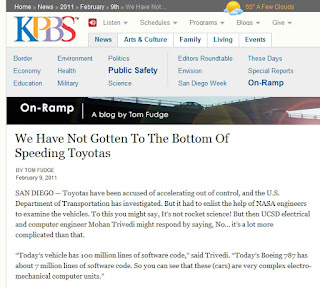
Tom Fudge from KPBS has an interesting piece on speeding Toyatas, with insights from two Jacobs School of Engineering professors: computer science (CSE) professor Ingolf Krueger and electrical engineering (ECE) professor Mohan Trivedi.
Tuesday, February 8, 2011
Nuno Vasconcelos Electrical Engineering Professor Quoted in Wall Street Journal
ECE prof Nuno Vasconcelos is quoted in an interesting story on counting crowds in Cairo by Wall Street Journal reporter Carl Bialik. Check out the Statistical Visual Counting Lab site.

Tuesday, January 18, 2011
NOVA: Making Stuff Stronger / Jacobs School Research

January 19 is the premier of "Making Stuff: Stronger" on NOVA. I haven't seen the show, but from the preview it looks like research from Jacobs School of Engineering professor Marc Meyers made it into the final version. Meyers is a professor in the Department of Mechanical and Aerospace Engineering (MAE).
Monday, November 22, 2010
UCSD@50 Special Section in the San Diego Union Tribune
 On Sunday Nov 14, the Union Tribune ran a special section outlining some of the history and highlights of UC San Diego's first 50 years.
Check out the coverage online: http://www.signonsandiego.com/ucsd-50/
Below is a screen shot of one of the pages. It includes future looking quotes from UC San Diego Bioengineering professor Gert Cauwenberghs and NanoEngineering professor Joseph Wang.
The special section includes information on how structural engineers from the UC San Diego Jacobs School of Engineering played an important role in retrofitting bridges to prepare them for earthquakes.
(That same page also has a great image of Jacobs School undergrads floating in near-zero gravity in order to made better space toilets.)
Thursday, October 21, 2010
Union Tribune Story: UCSD part of $1.6 million smart-grid grant

Monday, September 13, 2010
UC San Diego Engineering mentioned in Union Tribune look-back story on 9-11-2001
The San Diego Union Tribune story, "How the 9/11 attacks changed life in San Diego: Aftereffects of terrorist attacks include longer waits at the border, tighter security for travelers and military growth" mentions research being done here at the Jacobs School of Engineering.

Thursday, August 19, 2010

Subscribe to:
Posts (Atom)