Three teams taking an introductory aerospace engineering course this quarter got a unique opportunity last week: they launched three balloons, for which they designed payload and instrumentation.
The students were hoping the balloons would make it to the East Coast. But the ferocious windstorm that blew through the Southwest derailed their plans.
One balloon landed about 50 miles east of Yuma, Ariz., and was recovered by local residents. Another landed 120 miles south of Ensenada, in Mexico, and was also at a local home. Finally, the third balloon touched down 40 miles east of Kingman, Ariz. It's in a remote mountain area, so Kosmatka plans to contact a local Boy Scout troop to help recover it.
The students' efforts were profiled in this San Diego Union-Tribune story.
Also, read our story on the Jacobs School website.
Snapshots from the UC San Diego Jacobs School of Engineering.
Monday, December 5, 2011
Thursday, December 1, 2011
Deadlin Extended: Fall Elevator Pitch Competition Entry Deadline
Deadline has been EXTENDED!!
If you've ever had an idea for a business here is your chance to showcase it--and maybe win some money!
1 Page (550 words), $1,000 awarded to the top idea.
The top 8 ideas as evaluated by our judging consortium will pitch their idea live to the audience at our 2011 Winter KickOff in January.
An audience vote will determine who walks away with $1,000.
Link for Submitting Entry:
http://challenge.ucsd.edu/? page_id=778
Judging Criteria : http://challenge.ucsd.edu/? page_id=26
Link for Submitting Entry:
http://challenge.ucsd.edu/?
Judging Criteria : http://challenge.ucsd.edu/?
We all have ideas, submit yours!
Deadline: Tomorrow Friday, December 2, 2011 by 11:59pm
http://challenge.ucsd.edu
Wednesday, November 30, 2011
Nurture Affects Gender Differences in Math Abilities, Researcher Says
Nurture plays an important role in shaping math abilities for both men and women, says Moshe Hoffman, a postdoctoral researcher with a joint appointment at the Jacobs School of Engineering and Rady School of Management. That's the conclusion that Hoffman and his Rady School adviser, Uri Gneezy, reached after conducting an extensive study published earlier this year in Proceedings of the National Academy of Sciences.
Hoffman will present his findings during a talk at 2 p.m. today at the Qualcomm Conference Room at Jacobs Hall.
His study already has generated a wave of media coverage. Some examples below:
Time Magazine
Wired
The Wall Street Journal
KPBS
Also, here is the abstract of the paper:
Women remain significantly underrepresented in the science, engineering, and technology workforce. Some have argued that spatial ability differences, which represent the most persistent gender differences in the cognitive literature, are partly responsible for this gap. The underlying forces at work shaping the observed spatial ability differences revolve naturally around the relative roles of nature and nurture. Although these forces remain among the most hotly debated in all of the sciences, the evidence for nurture is tenuous, because it is difficult to compare gender differences among biologically similar groups with distinct nurture. In this study, we use a large-scale incentivized experiment with nearly 1,300 participants to show that the gender gap in spatial abilities, measured by time to solve a puzzle, disappears when we move from a patrilineal society to an adjoining matrilineal society. We also show that about one-third of the effect can be explained by differences in education. Given that none of our participants have experience with puzzle solving and that villagers from both societies have the same means of subsistence and shared genetic background, we argue that these results show the role of nurture in the gender gap in cognitive abilities.
Here is the full text of the paper.
Make sure to stop by and listen in!
Hoffman will present his findings during a talk at 2 p.m. today at the Qualcomm Conference Room at Jacobs Hall.
His study already has generated a wave of media coverage. Some examples below:
Time Magazine
Wired
The Wall Street Journal
KPBS
Also, here is the abstract of the paper:
Women remain significantly underrepresented in the science, engineering, and technology workforce. Some have argued that spatial ability differences, which represent the most persistent gender differences in the cognitive literature, are partly responsible for this gap. The underlying forces at work shaping the observed spatial ability differences revolve naturally around the relative roles of nature and nurture. Although these forces remain among the most hotly debated in all of the sciences, the evidence for nurture is tenuous, because it is difficult to compare gender differences among biologically similar groups with distinct nurture. In this study, we use a large-scale incentivized experiment with nearly 1,300 participants to show that the gender gap in spatial abilities, measured by time to solve a puzzle, disappears when we move from a patrilineal society to an adjoining matrilineal society. We also show that about one-third of the effect can be explained by differences in education. Given that none of our participants have experience with puzzle solving and that villagers from both societies have the same means of subsistence and shared genetic background, we argue that these results show the role of nurture in the gender gap in cognitive abilities.
Here is the full text of the paper.
Make sure to stop by and listen in!
Friday, November 18, 2011
Jacobs School Photo Booth at UC San Diego Founders' Day Celebration
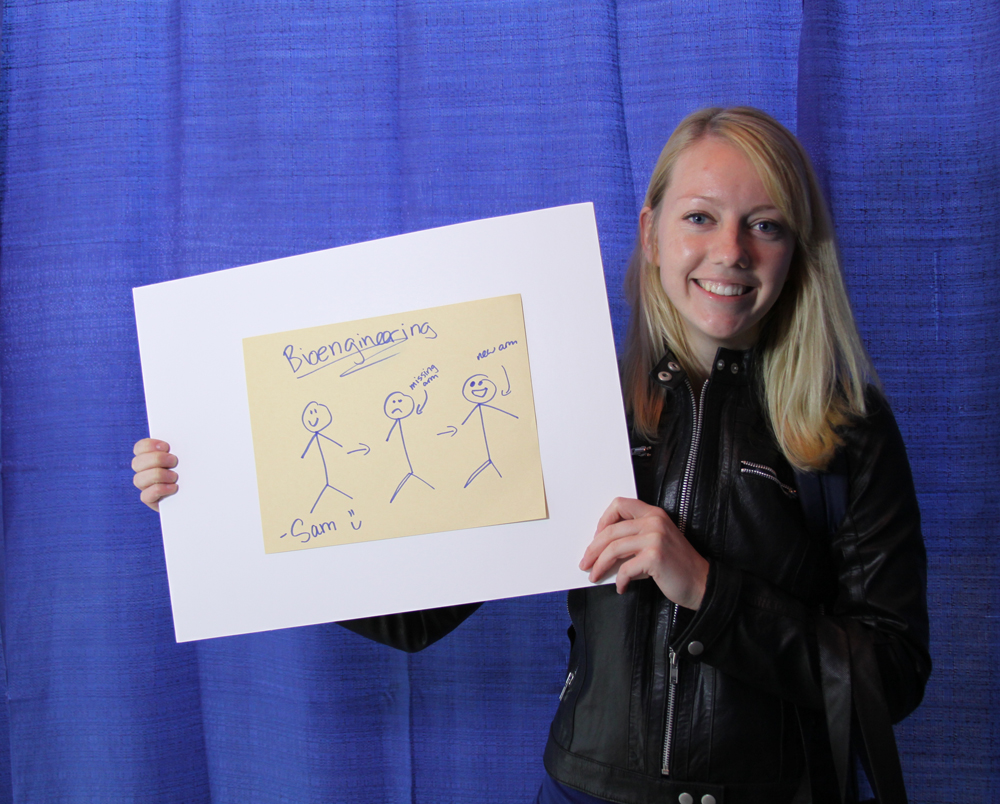
Here are some of our favorite photos from the Jacobs School of Engineering photo booth at the UC San Diego Founders' Day celebration. We asked people to draw or write down "What will be the next big innovation or invention?"
Renewable energy, health care and space travel / teleporting were popular, but answers spanned a wide range of topics. What will be the next big innovation or invention? How will it change the world? Your life? (Feel free to leave answers in the comments section, or on our Facebook page: http://www.facebook.com/UCSDJacobs
High resolution versions of these and more photos are on the Jacobs School of Engineering Flickr photostream. Even more photos from the photo booth are on our Facebook page.
A special thanks to Dr. Shu Chien for participating!
Renewable energy, health care and space travel / teleporting were popular, but answers spanned a wide range of topics. What will be the next big innovation or invention? How will it change the world? Your life? (Feel free to leave answers in the comments section, or on our Facebook page: http://www.facebook.com/UCSDJacobs
High resolution versions of these and more photos are on the Jacobs School of Engineering Flickr photostream. Even more photos from the photo booth are on our Facebook page.
A special thanks to Dr. Shu Chien for participating!
Thursday, November 17, 2011
Join Us at Founders' Day
Founders' Day is tomorrow and we hope you'll come to see us at our affinity booth. We want you to tell us what will be the next big innovation or invention that will change the world--and your life. You can draw or write your answer at our booth. We'll take your picture and post it on Facebook.
We'll be on Town Square starting at 11:30 a.m. Food trucks offering free food--that's right, we said free food--will be on hand starting at 12:30 p.m. There also will be a short program from noon to 12:30 p.m., including remarks by Prof. Adam Engler, from the department of bioengineering. See you there!
Founders' Day Fun this Friday, Nov 18, 2011
Founders' Day fun tomorrow. Check out the Jacobs School of Engineering booth. (Details on Founders' Day in the Union Tribune.)
Tuesday, November 15, 2011
DARPA Challenge Comes to UC San Diego
Every few years the Pentagon’s Defense Advanced Research Projects Agency (DARPA) holds a public competition to stretch the outer limits of what technology can do. Two years ago they dispersed 10 large, red weather balloons at undisclosed locations across the U.S. The celebrated 2009 DARPA Network Challenge to find the balloons was solved in just nine hours by a team from MIT. Now, Manuel Cebrian, a member of that winning team, is aiming for a repeat win – only this time, the challenge is exponentially harder.
According to Dr. Cebrian – who is now a research scientist at the University of California, San Diego – instead of just looking for 10 balloons, the new DARPA Shredder Challenge’s ultimate puzzle involves piecing together roughly 10,000 pieces of different documents that have been shredded. “This is almost certainly the most challenging puzzle ever created,” said Cebrian. “A combinatorial number of possibilities makes the problem intractable by computer algorithms alone. A combination of crowd-sourcing and advanced computer-vision algorithms is necessary. This is exactly our approach.”
Interested in participating or to learn more? Visit the UCSD Shredder Challenge Team online athttp://shredder-challenge.ucsd.edu.), or contact the UCSD team at shredder-challenge@ucsd.edu.
Subscribe to:
Posts (Atom)